San Marino from Bologna: The Oldest Republic, Three Towers on a Ridge, and a Passport Stamp for a Fee
Two and a half hours by train and bus, the world’s oldest republic — by its own tradition since the year 301 — runs three towers along a limestone ridge, stamps your passport for a fee, and has no border queue at all.
The short version
- The route per the alarm runs Bologna to Rimini by train in about an hour, then the international bus line’s fifty-minute climb from Rimini’s station to the capital on the ridge — a border crossed without controls, since the republic operates in open arrangement with Italy.
- The credential is the headline: San Marino claims continuous self-government since its founding by the stonemason Marinus in 301 — the world’s oldest extant republic by its own well-worn tradition, with statutes from 1600 among the oldest governing documents still argued about, per the alarm’s phrasing.
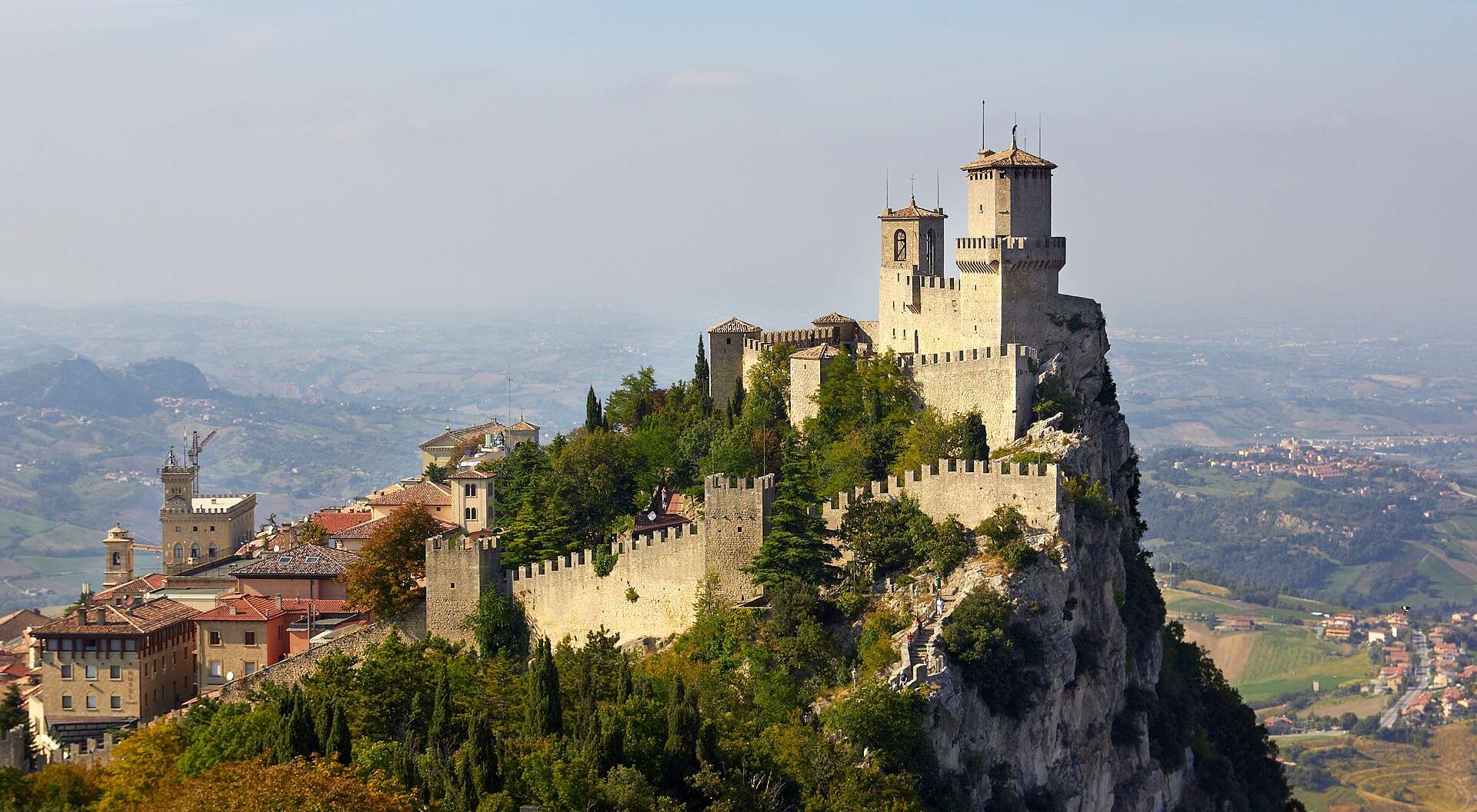
- The three towers run the ridge of Monte Titano: Guaita (the first tower, 11th-century bones), Cesta (the second, at the summit with its medieval-weapons museum), and Montale (the third, closed but walked to) — the UNESCO-listed skyline that every image of the republic is actually showing.
- The ridge walk between them is the visit’s spine: the Passo delle Streghe (Witches’ Passage) path along the cliff line, with the Adriatic one way and the Apennines the other, and the ticketed Guaita-Cesta pair covered on a combined entry.
- The passport stamp per the alarm is real bureau-tainment: the tourist office applies the republic’s visa stamp for a small fee — legally meaningless, universally beloved, and the souvenir the alarm named — alongside the republic’s own coins and stamps for collectors; visitor information at visitsanmarino.com.
- The shopping verdict stands: the lower streets run duty-free-adjacent retail (sunglasses, leather, an inexplicable density of replica weapons) mostly skippable per the alarm — while the crossbow corps’ summer displays, the Palazzo Pubblico’s guard, and the piadina lunch carry the actual local color.

Getting there
The train-bus combination per the alarm is the car-free answer, with the bus’s Rimini departure point a short walk from the station and the timetable photographed on arrival per standing habit — the last descent matters, since the ridge empties toward evening. Drivers climb the same road to parking tiers below the old town, then ride the funicular or walk the final pitch. The country’s smallness is the planning gift: the capital’s old town is the visit, and four to five hours cover it fully.
The day
The bus climbs out of the beach plain into limestone switchbacks and deposits you below the walls; the lanes do the rest of the ascent. Guaita first: the original fortress’s walls and cells, the flag over the drop, and the first full read of the ridge line you’re about to walk. The Witches’ Passage carries you to Cesta at the true summit — the weapons museum inside, the 360-degree panorama outside running from the Adriatic’s glitter to the Apennine wall — with Montale’s third tower as the quiet ten-minute extension. Back along the crest, the Palazzo Pubblico’s square handles the civic layer (the guard, the changing ceremony in season) and the stamp errand per the alarm settles the passport’s new page. Piadina lunch on a view terrace beats every duty-free storefront below it. The descent bus per the photographed timetable returns you to Rimini’s ordinary Italy, one country later.
When to go
April–June and September–October run the ridge at its clearest and the lanes at walking ease. July–August brings the Adriatic beach crowds up the hill in day-trip waves — early buses beat them — plus the crossbow corps’ summer calendar and medieval-days pageantry in the season’s heart. Winter strips the republic to locals, fog theatrics on the ridge, and towers on reduced hours: a moody, valid version for the few. Clear-day forecasting matters more than season per the ridge’s whole point; the summit in cloud is a different (and shorter) trip.
Frequently Asked Questions
Is it really the world’s oldest republic?
By its own continuous tradition — founded 301, self-governing through empires that swallowed everything around it, with early statutes still in legal force — the claim stands as the standard account, and the alarm’s old-enough-to-argue-about framing covers the scholarly hedging fairly. However dated, no one disputes the headline that matters: it never stopped being itself.
How does the passport stamp work?
The tourist information office in the old town applies the republic’s official visitor stamp for a small fee, on request, in seconds. It has no legal function (there’s no border control to satisfy) and total charm value. Travelers whose home countries frown on novelty stamps in passports know who they are and act accordingly.
Are the towers worth the ticket?
Guaita and Cesta on the combined entry, yes — the interiors are modest but the wall-walks, the cliff exposure, and Cesta’s summit panorama are the republic’s entire visual argument. Montale’s exterior walk is free. The Witches’ Passage between them costs nothing and outperforms both interiors on the right sky.
What’s actually worth buying?
The republic’s own coins and stamps for collectors, the passport stamp per the alarm, and proper piadina — beyond that, the duty-free-adjacent retail (fragrance, sunglasses, the replica-weapon shops that startle every first-timer) is priced for impulse rather than value. The alarm’s mostly-skippable verdict is the consumer report.
San Marino or Ravenna from Bologna?
Ravenna (documented on this network) for the mosaic ensemble — one of Italy’s great art days; San Marino for the ridge, the towers, and the collect-a-country novelty done right. Interior gold versus exterior stone — and since both route through the same rail corridor, the ambitious week stages them on consecutive days from the same base.