Ferrara from Bologna: The Renaissance’s Planned City, a Moated Castle Mid-Town, and Nine Kilometers of Walls by Bicycle
Half an hour north, the Renaissance’s planned city — the Este dukes drew Europe’s first modern street grid, a moated castle sits mid-town like it’s normal, and the city rides nine kilometers of walls by bicycle.
The short version
- Trains run Bologna to Ferrara in 30–45 minutes at commuter fares (trenitalia.com), with bike-rental shops at the station serving the local idiom per the alarm — Ferrara cycles at densities Italy otherwise reserves for Vespas.
- The planning credential is the UNESCO citation: Duke Ercole I’s 1490s Addizione Erculea doubled the medieval city on a rational grid — counted among Europe’s first modern urban plans — and the seam between organic lanes and Renaissance boulevards still reads street by street.
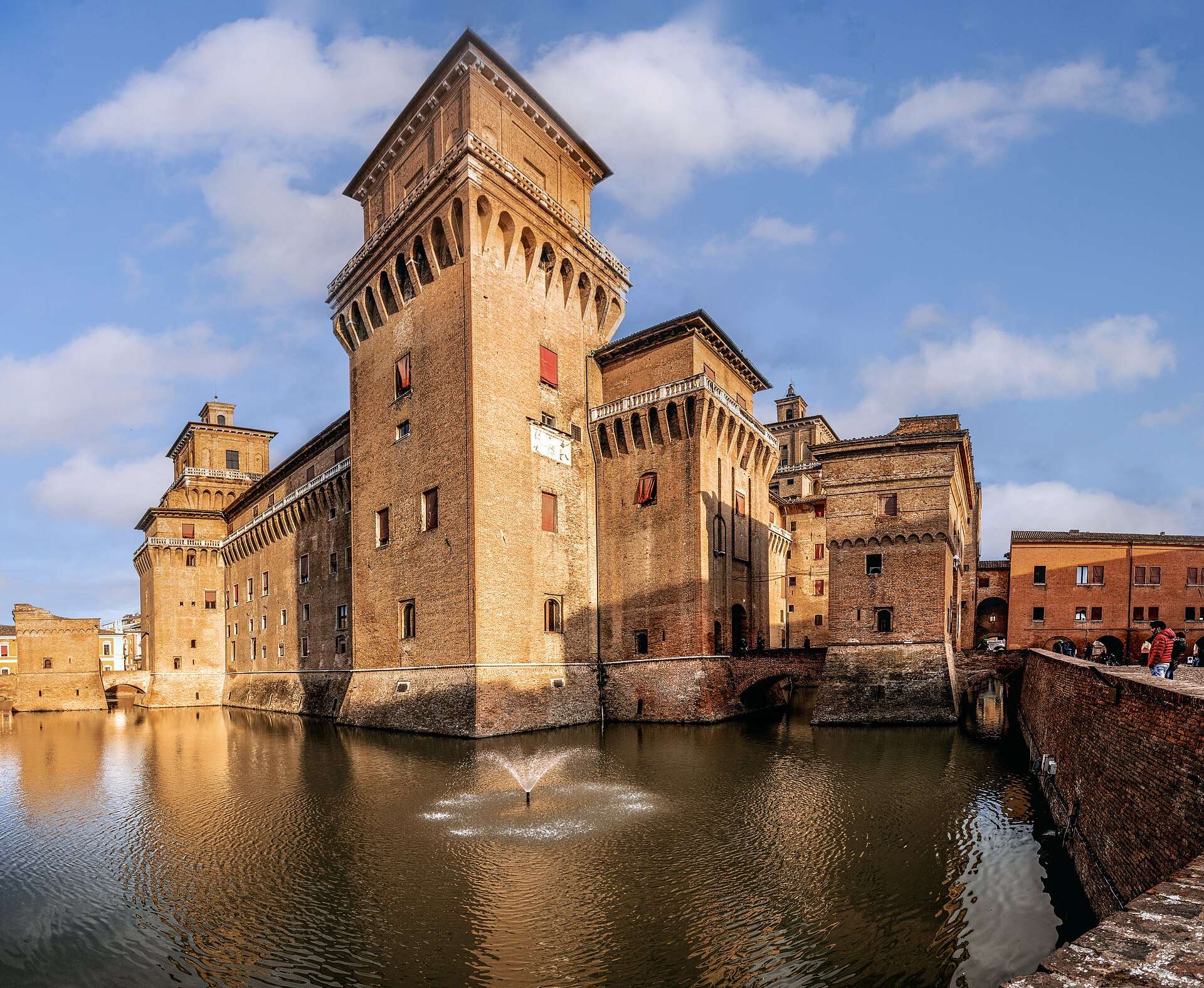
- The Castello Estense per the alarm sits moated mid-town: drawbridges, brick towers, and the Este dukes’ court rooms above the dungeons where the family’s darker episodes (Ugo and Parisina’s the famous one) are told straight on the visit (castelloestense.it).
- The walls ride is the alarm’s set piece: some nine kilometers of Renaissance ramparts circle the city as a tree-lined park path — flat, continuous, and the single best hour of cycling this network knows in an Italian city.
- The Palazzo dei Diamanti carries the count: the facade’s ~8,500 pointed marble blocks — the diamond of the Este device multiplied into architecture — with the gallery inside running serious rotating exhibitions.
- The Jewish-Ferrara layer per the alarm: the ghetto’s lanes (Via Mazzini and its synagogues), Bassani’s Garden of the Finzi-Continis as the literature (the garden itself fiction, the deportations fact), and MEIS — the national museum of Italian Judaism — giving the history its designed hour; cappellacci di zucca (butter-sage or ragù per season and argument) and salama da sugo close the table register.
Getting there
The train-plus-bike combination per the alarm is the whole method: rent at the station, and the flat city plus the walls circuit turn distance into pleasure. The castle anchors the center; the Addizione’s boulevards run north of it, the medieval tangle and ghetto south — the seam itself worth riding twice. Monday closures thin the museums; the walls and the grid never close. Fog season (November–February) is the city’s own register — the Po valley’s soft grey that Ferrara’s painters and filmmakers made a style.
The day
The castle opens it: moat, drawbridge, the court floors’ frescoes and the dungeon level’s cold telling of Parisina — the Este glamour and menace in one building. The bike then takes over per the alarm: up Corso Ercole I d’Este — the Addizione’s showpiece axis, palace-lined and traffic-light — to the Diamanti’s glittering count, then onto the walls: the nine-kilometer ring ridden among joggers and grandmothers, bastion by bastion, the city on one side and the green beyond on the other. Lunch is cappellacci per the season’s sauce. The afternoon rides south into the medieval half: the cathedral’s facade and the Loggia dei Merciai, Via delle Volte’s arched alley running like a rumor, the ghetto lanes and MEIS per the alarm’s give-them-their-hour clause. An aperitivo in Piazza Trento e Trieste and the half-hour train close a day that pedaled through two city plans and five centuries.
When to go
Spring and fall run the walls ride and the boulevards at their best; summer works on early rides and long lunches as the plain heats. Winter’s fog per the local register wraps the castle and lanes in the grey the city considers its true color — a moody, valid version with the museums as anchors. The Palio di Ferrara (late May) fills the piazzas with the districts’ processions — the city claims deep seniority for it — and the buskers’ festival (late August) turns the grid into stages.
Frequently Asked Questions
What made the street plan so important?
Ercole I’s addition wasn’t accretion but design: straight axes, proportioned blocks, and palace fronts conceived as an ensemble — urban form as Renaissance art, decades before anyone else tried at scale. Planning historians count it the first modern European plan, which is the UNESCO listing’s core. The lesson is readable by bicycle in a way maps can’t deliver, per the alarm’s whole method.
What happened to Ugo and Parisina?
The castle’s dark celebrity case: in 1425 Marquis Niccolò III had his young wife Parisina and his son Ugo executed in the dungeons below for their affair — a story Byron versified and the castle tour tells straight at the cells themselves. The Este ran magnificence and menace as one operation; the building still transmits both.
Is the Finzi-Continis garden visitable?
No — Bassani invented the garden, which is the point the alarm makes plainly: the novel’s walled paradise was fiction, while the world it mourned was real. The ghetto streets, the synagogues’ building, the 1943 deportation history, and MEIS’s national telling are the visitable substance. Literary pilgrims ride the wall stretch by the Charterhouse cemetery where Bassani rests.
Why is everyone on bicycles?
Flat geography, a compact plan, and decades of habit: Ferrara counts among Europe’s highest cycling-share cities, and the bike is class-free local transport — dukes’ boulevards to market lanes. Renting one per the alarm isn’t tourist theming but joining the traffic system; the walls circuit is its masterpiece stage.
Ferrara or Ravenna from Bologna?
Both documented on this network: Ravenna for the mosaic ceilings and Dante’s tomb; Ferrara for urban form, the castle, and the ride. Byzantine gold versus Renaissance geometry — the honest Bologna hub runs both half-hour spokes, and Ferrara is the one that hands you handlebars.