15 Bologna Hotels Under the Porticoes, Plus One Tower
A Roman road under the Majestic’s basement, an inn on the same spot since 1375, a twelfth-century tower rented whole, and a wooden portico with three assassins’ arrows in its ceiling.
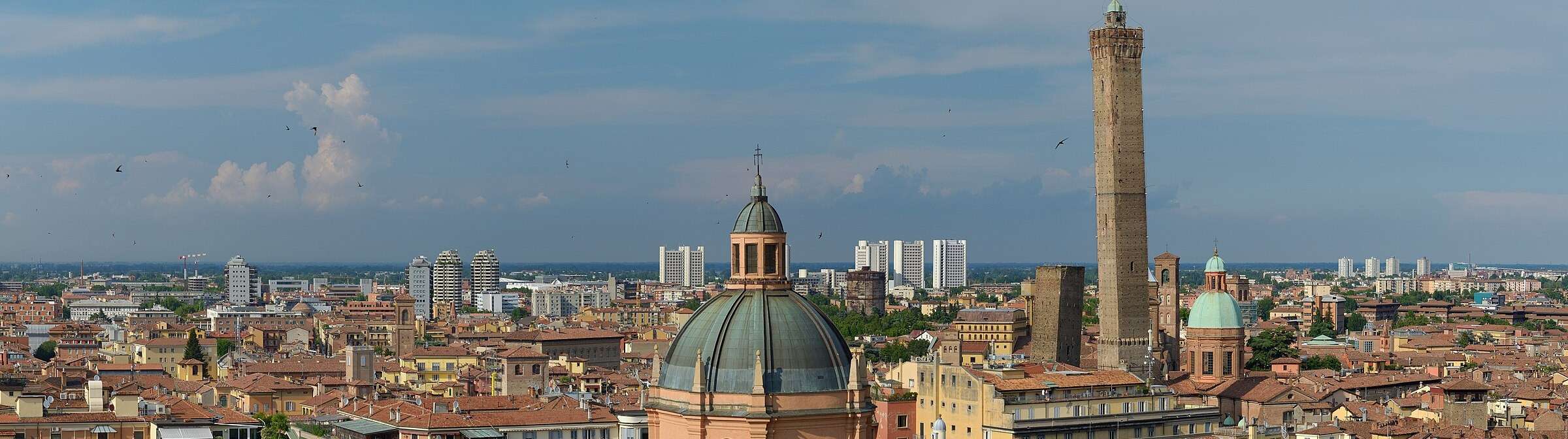
Bologna keeps its hotels under the porticoes and, in one case, inside a twelfth-century tower. This list has the Grand Hotel Majestic, with a Carracci ceiling over its restaurant and a Roman road in the basement, the Cappello Rosso, an inn on the same spot since 1375 by its own account, Casa Isolani under one of the oldest wooden porticoes in the city, and the Torre Prendiparte, which held the archbishop’s prisoners and is now rented to one party at a time.
The list is grouped by character, not ranked. Where a hotel’s own site could be confirmed, its name links there; the rest are listed without one.
Grand dames and old inns
Grand Hotel Majestic già Baglioni · Via Indipendenza / Centro Storico
The Majestic opened in 1912 as the Hotel Baglioni in an eighteenth-century palazzo on Via Indipendenza that adjoins the Renaissance Palazzo Fava. Its I Carracci restaurant sits under a sixteenth-century ceiling frescoed by the Carracci workshop, originally part of Palazzo Fava. A stretch of Roman road is kept on view in the basement, and the hotel counts Princess Diana and Frank Sinatra among past guests.
Hotel Corona d’Oro 1890 · Centro Storico / Via Oberdan (former Ghetto)
The Corona d’Oro has operated as a hotel since 1890 in a building whose oldest parts date to the fourteenth century, in the former Ghetto. The hotel links the house to the Azzoguidi family, whose press printed Bologna’s first book in 1471, and a Liberty-style glass-roofed hall from the 1890 refit survives at the heart of the building.
PHI Hotel Bologna Al Cappello Rosso · Centro Storico / Piazza Maggiore (Via de’ Fusari)
An inn has stood on this spot under the Cappello Rosso name since 1375, by the hotel’s account, which traces the name to the red hat on its medieval sign. It took the PHI Hotels name while keeping Al Cappello Rosso in its title, a few steps from Piazza Maggiore.
I Portici Hotel Bologna · Via Indipendenza
I Portici occupies the Palazzo Maccaferri, a late nineteenth-century palazzo at Via Indipendenza 69. The hotel’s Eden Theatre began as an early-1900s Liberty-style café-chantant and is still used for dining and events, and its I Portici restaurant has held a Michelin star.
Palazzo, tower and convent conversions
Art Hotel Commercianti · Centro Storico / Piazza Maggiore (San Petronio)
The Commercianti stands in a twelfth-century building on Via de’ Pignattari directly beside the Basilica of San Petronio. The hotel says the building was the first seat of Bologna’s city council in the 1100s; medieval beams and traces of frescoes survive in the upper rooms.
Casa Isolani Residenze d’Epoca · Santo Stefano / Strada Maggiore
Casa Isolani’s rooms sit inside the Isolani complex, whose Corte Isolani passage links Strada Maggiore to Piazza Santo Stefano. The thirteenth-century wooden portico, nine metres high on oak posts, is one of the oldest surviving in Bologna. Legend says the three arrows lodged in its ceiling were fired by assassins distracted by a naked woman at a window.
Torre Prendiparte · Centro Storico / Cattedrale di San Pietro
The Prendiparte is a twelfth-century tower about sixty metres tall, the second-highest still standing in Bologna after the Asinelli. It served as a prison for the archbishop’s court in the eighteenth century, and prisoners’ graffiti survives on the walls. It is rented in its entirety to one party at a time, and reopened to guests in early 2026 after a closure.
Il Convento dei Fiori di Seta · Santo Stefano / Via Orfeo
The Convento dei Fiori di Seta, the Convent of Silk Flowers, is a former convent on Via Orfeo turned into a small hotel. The hotel dates the convent to the fifteenth century and keeps original frescoes in several rooms.
Houses with a name around the piazza and the university
Art Hotel Orologio · Centro Storico / Piazza Maggiore
The Orologio is named for the clock tower of Palazzo d’Accursio, a few steps away on Piazza Maggiore, and the upper rooms look onto the palazzo and the piazza. It is one of the four family-run Bologna Art Hotels, with the Commercianti, the Novecento and the Corona d’Oro.
Art Hotel Novecento · Centro Storico / Piazza Galileo
The Novecento sits on Piazza Galileo, one block west of Piazza Maggiore. It was designed in the manner of the early-1900s Viennese Secession, with the name marking the century, by the hotel’s account.
Albergo Rossini 1936 · Università / Via Zamboni (Teatro Comunale)
The Rossini opened in 1936 on Via del Bibiena, beside the Teatro Comunale in the university quarter. It is named for Gioachino Rossini, who trained at Bologna’s Liceo Musicale and later returned to direct it, and was rebuilt as a boutique hotel while keeping the 1936 date in its name.
Hotel Roma · Centro Storico / Via d’Azeglio
The Roma stands under the porticoes at Via Massimo d’Azeglio 9, a few doors from Lucio Dalla’s house at number 15, on the pedestrian stretch that runs straight into Piazza Maggiore. It is family-run, with a traditional wood-panelled interior.
Antica Residenza d’Azeglio · Porta Saragozza / Via d’Azeglio
The Antica Residenza d’Azeglio is a room-and-breakfast at Via Massimo d’Azeglio 64, toward the Saragozza end of the street, a short walk from Porta Saragozza, where the San Luca portico begins. The rooms keep the palazzo’s frescoed ceilings and period furniture, by the house’s account.
Villas and the hills
Palazzo di Varignana · Colli / Varignana (Castel San Pietro Terme), outside town
Palazzo di Varignana is an eighteenth-century Palazzo Bentivoglio in the hills at Varignana, about twenty kilometres southeast of Bologna, opened as a resort in 2014. It is listed among the historic houses of Dimore Storiche Italiane, and the grounds include the Carlico labyrinth, a maze planted in the orchard.
Villa Aretusi · Borgo Panigale (west, toward the airport)
Villa Aretusi is a villa with a park in Borgo Panigale, on the western edge of Bologna, run as a hotel and restaurant. The owners present the house as a historic country mansion, and the villa and its restaurant are the draw.
Frequently Asked Questions
Are these hotels ranked?
No. The groups sort them by character, and the order within each group carries no meaning.
What made a hotel interesting enough for this list?
A story. Every entry was a grand dame or an old inn with a documented past, a palazzo, tower or convent that became a hotel, a house with a name attached, or a villa in the hills. Comfort alone did not qualify.
Why are there no prices?
Rates change daily and a priced list goes stale in a month. Where a hotel runs its own site, its name links there, so you see the current rate and book direct.
Is the centre of Bologna walkable from these hotels?
Yes. Everything inside the old walls sits within twenty minutes on foot under the porticoes, and the Centro Storico hotels on this list are all within ten minutes of Piazza Maggiore. Palazzo di Varignana and Villa Aretusi are the two exceptions, out in the hills and on the western edge.
Which hotel puts me closest to the day trips on this site?
Most day trips from Bologna run to Modena and the Motor Valley, to Parma, to Ravenna’s mosaics, to Ferrara, or into the hills for Dozza and the wine country. The Via Indipendenza hotels sit closest to Bologna Centrale station and the coach pickups.